












Responsible Supply Chain Management

Responsible Supply Chain Management at a Glance
MEGA manages its supply chain through supplier selection, supplier registration, Supplier Code of Conduct, evaluation questionnaires, supplier engagement, supplier audits and continuous monitoring. This section should be visual-led because the evidence is direct and useful for ESG assessment.
- Supply Chain Risk Management
- Supplier Code
- Supplier onboarding
- Tier-1 supplier evaluation in 2025
- Supplier evaluation cycle
- Supplier audits conducted in 2025
- Supplier audit coverage
- Supplier engagement
- Supplier capacity building
- Anti-corruption engagement
Challenges and Opportunities
Healthcare supply chains must be reliable, ethical and quality-driven. Materials and services used in pharmaceutical and healthcare businesses can affect product quality, cost, regulatory compliance, supply continuity and stakeholder trust. At the same time, suppliers operate in different countries and business environments, with different levels of maturity on human rights, safety, anti-corruption, environmental compliance and data protection.
For MEGA, the challenge is to maintain supply reliability while ensuring that suppliers understand and follow responsible business expectations. Supplier management must therefore go beyond purchasing. It must support quality, compliance, ethical conduct, human rights, workplace safety and long-term continuity.
The opportunity is to build stronger supplier partnerships. When suppliers understand MEGA’s expectations, are evaluated before onboarding, are engaged regularly and are audited periodically, the supply chain becomes more resilient. This helps MEGA maintain quality products, manage risks and support affordable healthcare in the markets we serve.
Product quality depends on reliable suppliers and compliant materials
Strengthen supplier selection, regulatory evaluation and supplier audits
Suppliers may operate with different standards across countries
Use the Supplier Code of Conduct and evaluation checklists to align expectations
Human rights, safety and labour risks can occur in supplier workplaces
Evaluate suppliers on human rights, workplace safety and related risk areas
Supply disruption may affect product availability and business continuity
Build long-term supplier relationships, supplier rotation plans and continuity measures
Bribery and unethical conduct can affect business relationships
Encourage Supplier Code compliance, anti-bribery standards and CAC participation
ESG expectations are expanding across the value chain
Strengthen supplier engagement, audit coverage and transparent disclosure of supplier management results

Why Responsible Supply Chain Management Matters to MEGA
MEGA’s purpose is to help people stay healthy as long as they live. This purpose depends on our ability to provide quality products and services through a supply chain that is reliable, ethical and resilient.
Responsible supply chain management matters because it connects directly to product availability, affordability and quality. MEGA works in developing and underdeveloped markets where cost, supply continuity and product reliability can influence access to healthcare. We therefore work with suppliers to reduce costs, optimize supply chain efficiency and sustain quality standards without compromising ethics, integrity or regulatory compliance.
A responsible supply chain also protects trust. Suppliers are part of the wider MEGA value chain, and their practices can affect human rights, safety, environmental compliance, business ethics, product quality and continuity. This is why MEGA sets clear expectations and uses supplier evaluation and audits to understand and manage risks.
Our Supplier Management Approach
MEGA’s supplier management approach begins before a supplier is added to the Approved Suppliers List. Suppliers are evaluated through questionnaires and assessment processes to help MEGA understand potential risks and ensure that suppliers can support MEGA’s expectations.
The Supplier Code of Conduct provides the principles of engagement with suppliers. It sets expectations on business ethics, compliance with laws, environmental responsibility, human rights, occupational health and safety, fair payment practices, confidentiality and responsible conduct. MEGA also uses supplier and regulatory evaluation checklists to evaluate important risk areas, including human rights, non-discrimination, child labour, anti-corruption, business ethics, data protection, environmental and regulatory compliance, freedom of association, health and safety, confidentiality, competition practices, sanctioned individuals and supplier remuneration.
After onboarding, supplier management continues through engagement, periodic communication, capacity building and supplier audits. MEGA engages suppliers through regular meetings, supplier training programs, MEGA training programs where relevant, Supplier Code communication and audit activities. The aim is not only to identify risk, but also to work with suppliers to build a more resilient and sustainable supply chain.
Supplier Selection and Registration
Supplier selection is a critical control point. Before suppliers are included in the Approved Suppliers List, MEGA uses evaluation questionnaires to assess supplier-related risks and understand whether suppliers can meet the Company’s expectations
This process supports both quality and sustainability. In a healthcare business, suppliers must be able to support regulatory requirements, quality expectations and continuity of supply. At the same time, they are expected to operate with ethical business practices, respect for human rights, safe working conditions and compliance with applicable laws.
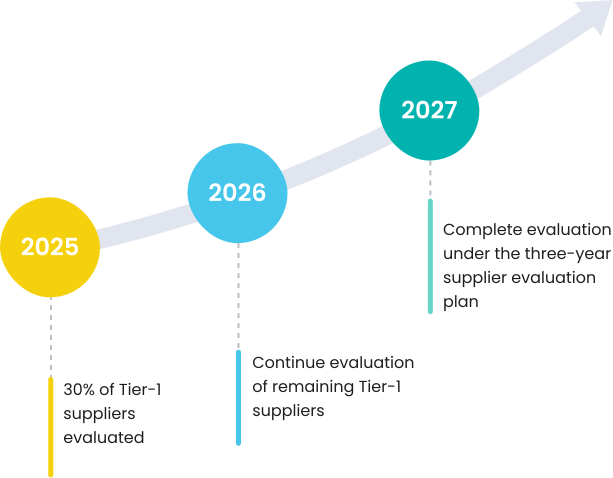
In 2025, MEGA evaluated 30% of Tier-1 suppliers. The remaining Tier-1 suppliers are planned to be evaluated in 2026 and 2027. MEGA has a system to evaluate 100% of suppliers over a three-year period based on plans developed in advance.
Supplier Evaluation Roadmap
Supplier Code of Conduct
The Supplier Code of Conduct sets the expectations for suppliers working with MEGA. It reflects MEGA’s belief that growth and excellence must be supported by sustainable, transparent and ethical business practices.
MEGA expects suppliers to conduct business with ethical standards and in accordance with applicable laws. Suppliers are expected to comply with local regulations, including environmental laws, anti-trust laws and labour laws, and to promote fair and competitive business practices. Suppliers must not offer, provide, demand, accept or receive bribery, excessive gifts, entertainment or other activities that may influence MEGA’s business decisions.
The Code also covers confidentiality, conflicts of interest, data protection, environmental management, human rights, fair wages and benefits, occupational health and safety, emergency preparedness, and compliance with agreements signed with MEGA. Supplier concerns can be raised through MEGA’s Audit Committee or whistleblowing channel, with non-retaliation principles applied before, during and after complaints.
Supplier Code Coverage
Supplier Evaluation Areas
MEGA’s supplier evaluation does not focus only on commercial capability. Supplier Code and regulatory evaluation checklists cover broader responsibility areas that are important to sustainable supply chain management.
The current supplier evaluation areas include human rights, non-discrimination, diversity, gender parity, child labour, anti-corruption, Business Ethics and Code of Conduct, data protection, environmental and regulatory compliance, freedom of association and collective bargaining, health, safety and hygiene at workplace, confidentiality, anti-trust / competition practices, sanctioned individuals and supplier remuneration.
This breadth is important because supplier risk can appear in many forms. A supplier may meet delivery expectations but still create risk through weak labour practices, poor safety controls, lack of confidentiality, corruption exposure or non-compliance with regulations. MEGA’s evaluation approach helps bring these topics into supplier screening and monitoring.
Supplier Engagement and Capacity Building
MEGA believes supplier relationships should be fair and long-term. We engage suppliers through regular meetings, supplier communication, Supplier Code activities and supplier audits. Where relevant, MEGA also attends supplier training programs or conducts MEGA training programs for supplier capacity building.
Supplier engagement is also part of MEGA’s stakeholder engagement process. Suppliers expect responsible supply chain practices, fair business partnerships and collaboration. MEGA responds through regular meetings, Supplier Code communication, supplier audits, fair relationships and long-term cooperation.
MEGA also encourages suppliers to comply with MEGA’s Supplier Code of Conduct and to consider joining the Thai Private Sector Collective Action Coalition Against Corruption or other anti-bribery standards encouraged by international agencies. This helps extend ethical business expectations beyond MEGA’s own operations and into supplier relationships.

Supplier Audits and Monitoring
Supplier audits help MEGA verify whether suppliers continue to meet expectations after onboarding. MEGA conducts audits of suppliers at least once every three years and has a three-year rotation plan to cover 100% of suppliers.
In 2025, MEGA conducted audits of 52 suppliers. Supplier audits included checks on Good Manufacturing Practices, Human Rights and Employee Health and Safety. These audit areas are important because they connect product quality with responsible workplace practices in the supply chain.
Supplier audits also support risk management. Findings from supplier engagement, evaluation and audits help MEGA understand supplier risk, identify areas requiring attention and support continuous improvement across the value chain.

Human Rights Across the Supply Chain
Human rights protection extends beyond MEGA’s own operations. MEGA uses supplier evaluation questionnaires before suppliers are included in the Approved Suppliers List, and supplier-related assessment is connected to human rights risk management across supplier workplaces.
In 2025, MEGA evaluated 30% of Tier-1 suppliers, with the rest planned for evaluation in 2026 and 2027. This supports MEGA’s system to evaluate 100% of suppliers over a three-year period. Supplier audits also include human rights and employee health and safety checks.

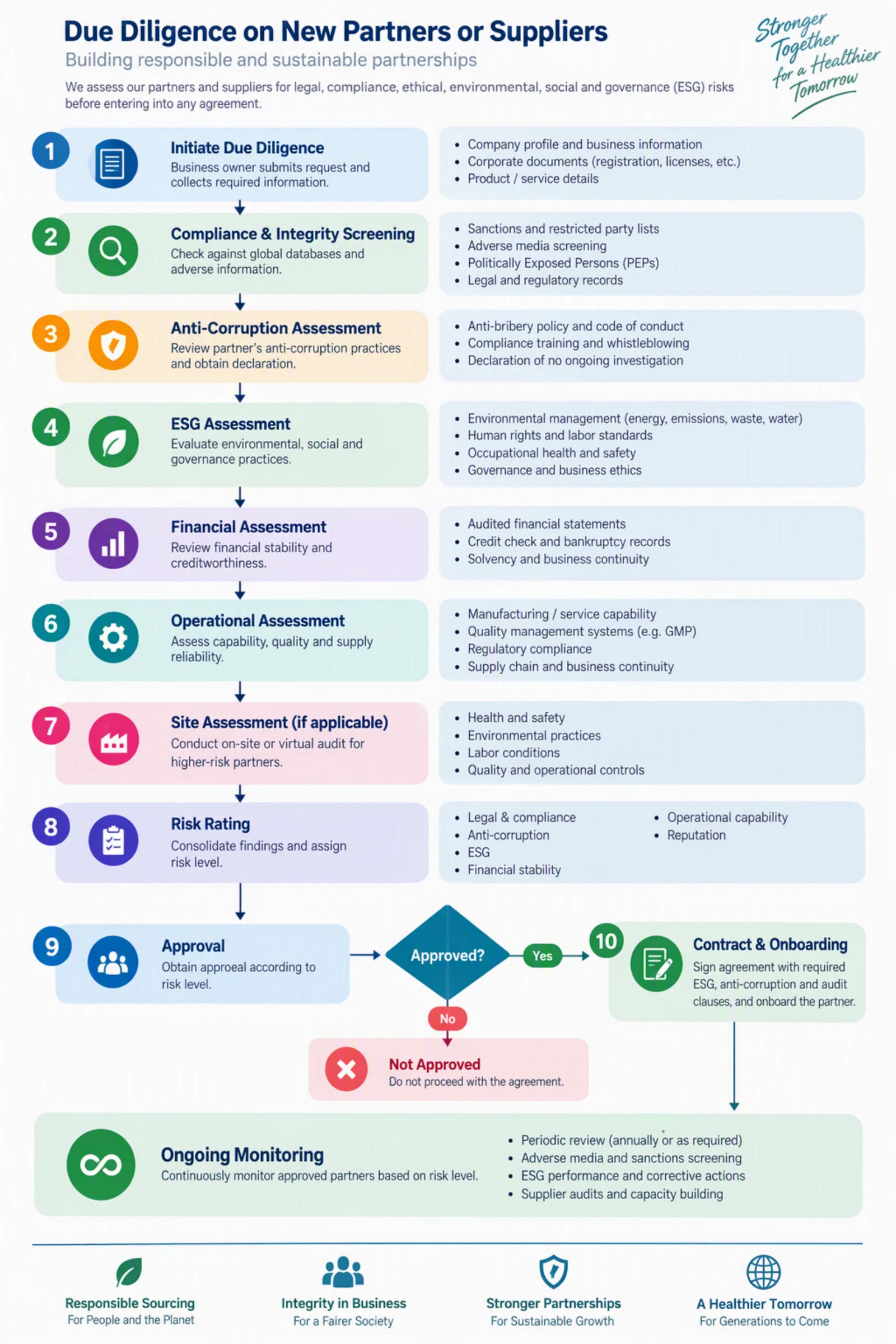
Due Diligence on New Partners or Suppliers
Building responsible and sustainable partnerships
We assess our partners and suppliers for legal, compliance, ethical, environmental, social and governance (ESG) risks before entering into any agreement.
Supply Chain Resilience and Responsible Sourcing
MEGA’s supply chain management also supports business continuity and healthcare access. As MEGA provides healthcare products in developing and underdeveloped markets, responsible sourcing and supply continuity help the Company maintain product availability and affordability.
MEGA works with suppliers to optimize supply chains and improve cost efficiency without compromising ethics, integrity, quality or regulatory compliance. Responsible product pricing is made possible in part by sustainable sourcing, supply chain efficiency and balanced relationships with stakeholders.
Supply chain resilience is also supported through long-term relationships with credible suppliers, supplier selection, follow-up audits, alternate approved suppliers, and business continuity measures. These practices help MEGA manage risks related to raw materials, excipients, quality standards and supply disruption.
Corrective Action, Concerns and Remediation
Responsible supply chain management requires a channel for concerns and a process for response. Suppliers and stakeholders may raise concerns through MEGA’s Audit Committee or whistleblowing channel. MEGA applies the principles of its Non-retaliation Policy before, during and after complaints.
MEGA investigates reports and takes appropriate remediation measures to prevent further wrongdoing and address past misconduct where the issue is determined through inquiry. This reinforces accountability and helps protect trust in supplier relationships.

Supplier/ Creditor
Our Company is committed to fulfilling all contractual obligations and financial responsibilities with transparency and integrity including maintaining punctual payment and quality of collateral. Together with our subsidiaries, we attempt to provide our creditors with full and accurate information about our progress, as required, through an ongoing face-to-face and quarterly financial disclosure on our website for smooth dealings and to comply with all our obligations.
We will promptly notify our creditors of any inability to meet our obligations and work towards mutually acceptable solutions. Moreover, we want to see our creditors adhere to business principles consistent with our own and ensure that their products and services are produced and delivered to comply with all legislation relevant to their business in the areas where they operate.
Conflict of Interest Policy training was delivered through on-site sessions at the Head Office, and an online session was provided to our units in Malaysia, Vietnam, Indonesia, and Myanmar.
For 2025, there was no material case regarding conflict of interest. Any minor non-compliance with our Conflict of Interest Policy was appropriately investigated and managed.
Policy and Practices for Creditors
The Board of Directors has established policies and practices to ensure that the Company treats its creditors with responsibility, transparency, and fairness, as follows:
- Treat all creditors, including trade creditors and financial institution creditors, fairly and equitably based on mutual benefit. The Company makes timely payments to maintain the credibility and trust of the Group with its business partners and financial institution creditors.
- Strictly comply with all contractual agreements and conditions, particularly those with financial institution creditors, including the purpose of fund utilization, repayment of principal and interest, and collateral requirements. The Company places great importance on prudent financial management to maintain a strong financial position and sufficient liquidity to meet its debt obligations on time. In addition, the Company regularly provides creditors with accurate and transparent financial information and reports in accordance with the agreed terms and conditions.
- If the Company is unable to maintain its financial status or comply with any loan agreement or contractual obligation for any reason that may result in a breach of contract, the Company will promptly notify the relevant creditors and work together to identify mutually acceptable solutions.
Disclosed Target / Management Focus
MEGA’s responsible supply chain management focus areas are connected to supplier onboarding, Supplier Code implementation, supplier evaluation, supplier audits, human rights, safety, business ethics, supply continuity and responsible sourcing.

Continue using supplier evaluation questionnaires before suppliers are included in the Approved Suppliers List.

Complete evaluation of remaining Tier-1 suppliers in 2026 and 2027 under the three-year plan.

Continue the system to evaluate 100% of suppliers over a three-year period.

Continue communicating and applying Supplier Code expectations across supplier relationships.

Continue supplier audits at least once every three years under the three-year rotation plan to cover 100% of suppliers.

Continue supplier audit coverage on Good Manufacturing Practices, Human Rights and Employee Health and Safety.

Continue supplier evaluation and audit processes to strengthen human rights expectations across supplier workplaces.

Continue regular meetings, supplier communication, capacity building and long-term cooperation.

Continue encouraging suppliers to comply with MEGA’s Supplier Code and consider CAC or other anti-bribery standards.

Continue optimizing supply chains to support quality, affordability, ethics, integrity and supply continuity.

Maintain supplier-related concern channels through Audit Committee / whistleblowing channels and non-retaliation principles.
